
Find and evaluate distributors in a new market.
Find distributors by product and market. Build a partner brief, assess customer and portfolio fit, and separate public evidence from direct qualification.
In This Guide 8
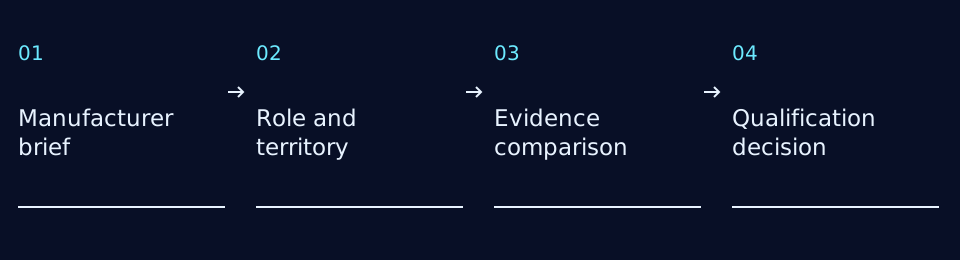
- 01Manufacturer brief
- 02Role and territory
- 03Evidence comparison
- 04Qualification decision
Start a distributor search with the product, target country and the work you need a partner to do. Then compare companies against that brief. This gives you a shortlist with reasons for outreach, rather than a list of businesses that happen to sell in the same category.
Before contacting candidates, make sure your own team can explain the offer: product range, target customers, pricing basis, supply arrangements and support. A distributor will need those details to assess the opportunity.
Define the partner’s job
“Distributor” is a useful search term, but it does not tell you who will sell, invoice, hold stock, install or support your product. Decide which responsibilities the partner needs to take on.
A company may combine distribution, integration and service work. Evaluate the tasks it can perform rather than rely on its directory label. If you need a stocking partner, a company that only introduces buyers may not meet the brief. If your product needs technical support, customer access alone may be insufficient.
Use this partner brief before expanding the search:
| Brief field | What your team should decide |
|---|---|
| Product | Product family, variants and documentation available |
| Target market | Country and territory to cover; territories already committed |
| Customer | Buyer types, industries and applications you want to reach |
| Partner responsibilities | Sales, stock, invoicing, installation and after-sales support as needed |
| Offer economics | Pricing basis and the commercial model you can explain |
| Supply and support | Order arrangements, technical support and language responsibilities |
| Constraints | Existing rights, exclusivity or product limitations to review |
| Next decision | Which candidates deserve outreach, and who will qualify them |
Do not expand the candidate search to compensate for a product offer that your own team cannot yet describe.
Search by product and geography together
Start with the product category and target country. Then examine whether the company’s customer segments and sales route match the product. A relevant distributor for industrial buyers may serve a different channel from a distributor focused on retail or installers.
Keep headquarters separate from territory evidence. An address in a country does not show which regions or customer groups the company covers. Look for product pages, represented brands, published locations and other sources that explain its activity.
Compare portfolio fit and possible conflict
Related brands can show familiarity with the product category. They can also raise questions about competition, exclusivity and attention. Record the brands and relevant product lines visible in the source; ask directly about restrictions or willingness to add your range.
Do not remove a candidate merely because a portfolio overlap exists. First establish whether the overlap is complementary, competitive or unresolved. Conversely, a clear gap in the portfolio does not establish demand for your product.
Build a distributor evaluation sheet
| Criterion | Public evidence to collect | Question for direct qualification |
|---|---|---|
| Product category | Relevant product and brand pages | Which parts of our range would you consider? |
| Customer fit | Described industries, applications and sales channels | Which customers could you reach for this product? |
| Territory | Sources describing locations or market activity | Which territory can you actively cover? |
| Portfolio | Related and competing brands | Are there conflicts or appointment restrictions? |
| Technical support | Published support or service capabilities | Who would handle training and after-sales work? |
| Commercial model | Any clearly stated operating role | Who stocks, invoices and carries the agreed responsibilities? |
| Interest and ownership | A relevant business enquiry route, where published | Who can assess a new manufacturer relationship? |
| Freshness | Source URL, document date and date checked | What has changed since the published information? |
Leave an unanswered direct question visible. A public profile can support a reason for contact; partner interest, territory commitments and appointment terms require a response from the company.
Decide who deserves outreach
Use three practical dispositions:
- Contact: the product, customer and channel evidence support a relevant enquiry; the unresolved questions can be asked directly.
- Clarify first: a critical role, territory or portfolio point is too uncertain for a useful approach.
- Remove from this search: a documented mismatch with a mandatory requirement makes outreach unlikely to help.
For each company kept on the shortlist, write a reason for contact and the first qualification question. Avoid ranking candidates through a single score that hides a critical conflict or missing requirement.
Make the first contact specific
Explain the product family, target customer and country, then ask whether the company is the right business to assess the opportunity. Share the relevant product information and ask who should review it. Treat a response as evidence of that response, not as an appointment or territory agreement.
Need distributors for a specific product and market?
Tell us the product category, target country and type of distributor you need. Mirianode can build a sourced Distributor Map showing relevant companies, their market fit and the questions that still need verification.
Your brief worksheet
Fill in what you know. Leave unresolved questions visible. These notes stay in this page and clear when you leave or refresh. Nothing here is submitted.